

Join Me on a Color Pilgrimage
Introducing an exclusive series on the wonders of color

“I found that I could say things with color and shapes that I couldn’t say in any other way—things I had no words for.”
- Georgia O’Keefe, interview in the 1977 documentary O’Keefe
Every so often, I become intensely interested in a new subject. Nothing makes me happier than a new preoccupation! It’s a wonderful, mysterious feeling to become wildly interested in something new, and I know exactly when my passion for color began.
In episode 71 of the Happier podcast, my sister Elizabeth and I shared the try-this-at-home suggestion to “Choose a signature color”—and soon we were inundated with responses.
While I loved learning about other people’s selections, somehow I couldn’t choose a signature color for myself. But the more I considered the question, the more the very subject of color gripped me, and—as I always do when an idea takes hold—I headed to the library.
It was there that my color pilgrimage began.

Color is an irresistible mystery
I’m fascinated by the paradoxical and elusive nature of color.
Color influences us, whether we’re aware of it or not. It’s a ubiquitous, conspicuous aspect of our world, but it’s unstable and hard to describe. Art can’t capture it; philosophy can’t make up its mind; science is unsatisfying; popular culture overstates. Color is an irresistible mystery.
We have thousands of terms to describe color, and yet words can’t convey it. As every child has discovered, what I call blue may not resemble what you call blue. In the end, to define a color, we’re forced to point to an example. I can’t convey the meaning of red by explaining it to you in different words, I have to point to objects and say, “This is red.”
Nevertheless, we try to use words and associations to convey color. In the past, colors often took their names from nature—olive green, lemon yellow—but now we’ve lost many of those color associations. These days, we’re more likely to be able to identify a color from a brand: Coca-Cola red, Starbucks green, Hermès orange.
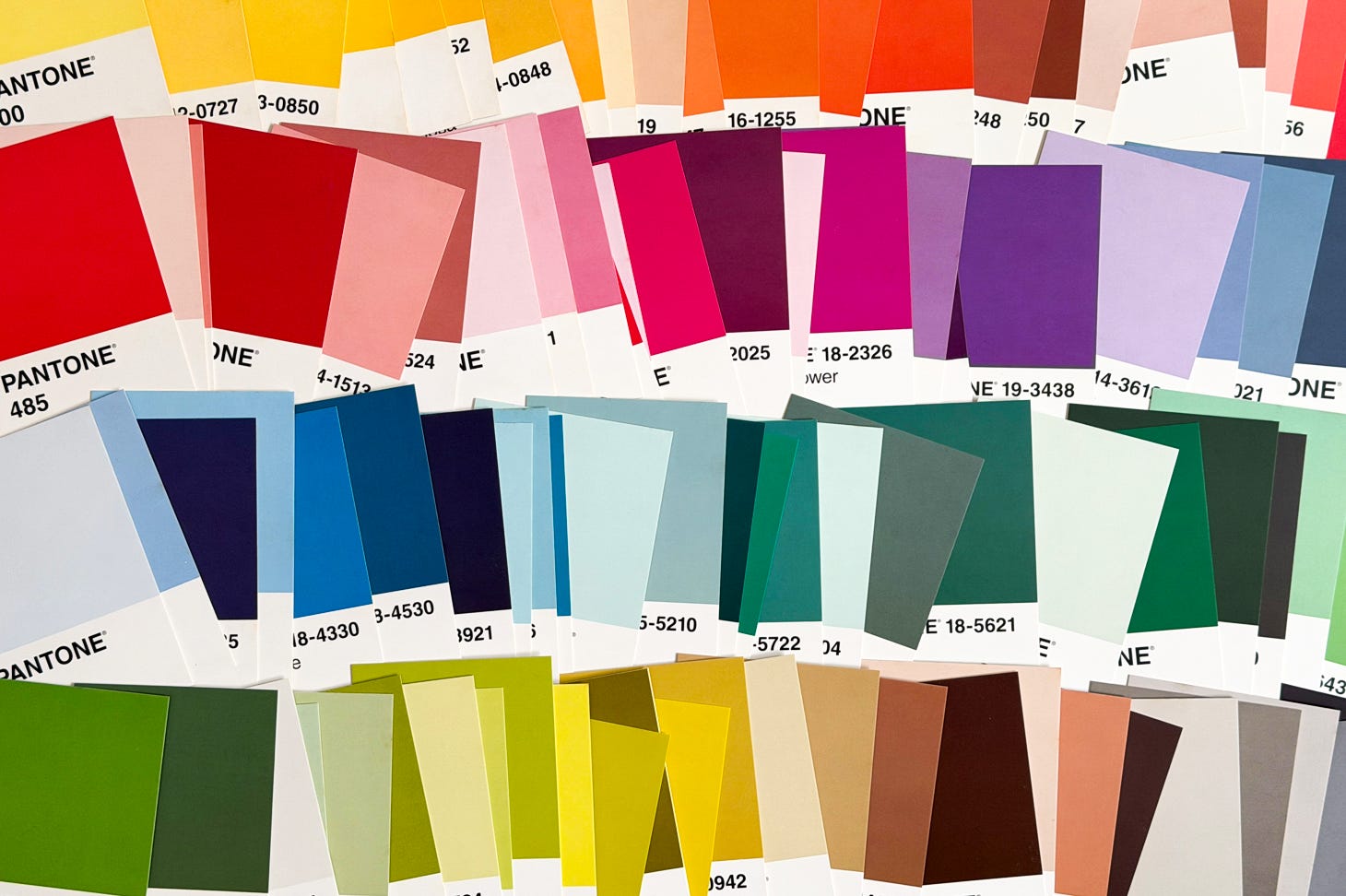
Because words are so imprecise, numbers become the solution. The Pantone Matching System and the ISCC-NBS System of Color Designation use numbers to identify colors. But while calling a particular color “10YR 7/12” may be more precise, it’s much less satisfying than “gamboge.” Numbers lack the beauty of evocative language, the delight of ochre, greige, chartreuse, cerise, aubergine, celadon, garnet, isabelline, orpiment, fallow, cornflower blue, library brown, Sunday white.
Color may be difficult to name, but that doesn’t excuse the fact that often we refer to objects by color names that are just plain wrong. “White” wine isn’t white. “Red hair” often isn’t quite red. (“Red carpets,” however, are almost always red.) The banana is an icon of “yellow,” but a banana is often green or brown. The sky is always described as “blue,” but very often appears white, gray, pink, orange, purple, or nearly black.
However named, colors remain obvious, much-discussed, and ultimately inexpressible.

Join me on a color pilgrimage
Each Tuesday in March, I’ll send out an exclusive essay on the mysteries and wonders of color—plus some of my favorite astonishing color facts. The full posts will only be accessible to paid subscribers. They are drawn from something I’ve been working on for years: a short book-length project titled (you guessed it) My Color Pilgrimage. This Substack series is the first time I’m sharing some of this writing.
If you’d like to join the color pilgrimage but aren’t yet a paid subscriber, upgrade your subscription to receive all five essays. When you upgrade, you’ll also get access to all paid subscriber content in the archives.
This color pilgrimage will explore topics ranging from forbidden colors to colors’ influence on the taste of food. Each essay will include a creative, actionable prompt so you can make your color pilgrimage. Paid subscribers will also be invited to share their own color observations in the comments. We can all learn from each other.
In this series, I’ll tell you some of the most fascinating facts I uncovered through my research.
For example:
“Mummy brown” paint was actually made from pulverized Egyptian human mummy remains
The blue hour of evening is also known as “owl-light”
In the 19th century, people were poisoned by their green wallpaper
If you’ve ever wondered whether “the dress” was white-and-gold or black-and-blue, and why people disagreed, or which color was the “first” color, join me.
I’m a color pilgrim, a color explorer, and this is my very idiosyncratic look at color. One thing is true: When I think about color, I see things in a way that I didn’t see them before.
The series starts on Tuesday, March 3. Come with me, immerse yourself in color. Subscribe today so you don’t miss a post.
Very excited to read Gretchen Rubin’s thoughts and insights about color. When I lived in WA , I had countless discussions about color with an artist friend. Today I’m Happier just thinking about expanding my thoughts with this series!
For a very fun ride on the topic of blue, I highly recommend Sacré Bleu, by Christopher Moore!